
The Portfolio You Chose, and the One It Turns Into
A paper on what rebalancing costs ends up defending it. Left alone, a 60/40 drifts to roughly 80/20 in a decade. The habit is worth keeping; the cost comes from doing it in lockstep.

Eighty/twenty. A recent paper (actually on the “cost” of rebalancing) says that this ratio is roughly where a 60/40 portfolio ends up if you leave it alone for a decade. The problem is, nobody buying a 60/40 product signs off on that kind of drift. There is no meeting and no moment where you look at the risk of suddenly holding four fifths of your money in stocks and say yes. The simple reason is, that stocks just grow faster than bonds for long enough, and thus the portfolio quietly becomes a different portfolio.
I start there because the paper actually became known for the opposite point. Its headline cost estimate (“rebalancing costs $16 billion”) reads like a case against rebalancing, and the easy takeaway is to not rebalance. The authors saw that coming and so they put real effort into insisting that rebalancing itself is not the villain. That is the part I find most interesting, because it is about a very human mistake: confusing the cost of doing something badly with the cost of doing it at all.
Drift feels like winning
Drift is a strange kind of risk because it looks like success. The stock half grows, the bond half lags, and every quarterly statement looks a little better. What actually happens is that the portfolio loses some of the diversification it was built for. It loses it during exactly the years when you are least likely to check. (The bill comes later, in the year stocks fall hard. An 80/20 falls noticeably harder that year than the 60/40 you thought you owned.)
On the habit itself, the paper is clear. Rebalancing, the authors write, “remains a fundamental tool for ensuring portfolio diversification, managing liquidity, and generating utility gains for mean-variance investors.” They also put numbers on that gain. They take 1997 to 2023 and an investor with a moderate dislike of risk (risk aversion γ = 3, in the economist’s notation). For that investor, rebalancing whenever the weights leave a 2.5% band beats buy-and-hold by about 18 basis points of utility. Rebalancing on a fixed calendar beats it by about 10.
Utility, for the non-economists, is return with a penalty for the bumps you had to sit through to earn it. Eighteen basis points does not sound like much, and on its own it isn’t. But it is a gain measured against doing nothing, and doing nothing is exactly what the cost headline invites you to do.
Imagine a thermostat, not an alarm clock
The gap between 18 and 10 is where my physicist brain gets interested. It is a control problem, and engineers worked out its basic shape a long time ago.
A calendar rule is a heater on a timer. It switches on at 6:00 whether the room is cold or not. A threshold rule is a thermostat with a dead band. It does nothing while the temperature stays inside a comfortable range and acts only when the room actually drifts out of it. The thermostat does less work and still keeps the room closer to where you want it. That is roughly what the 18-versus-10 comparison shows.
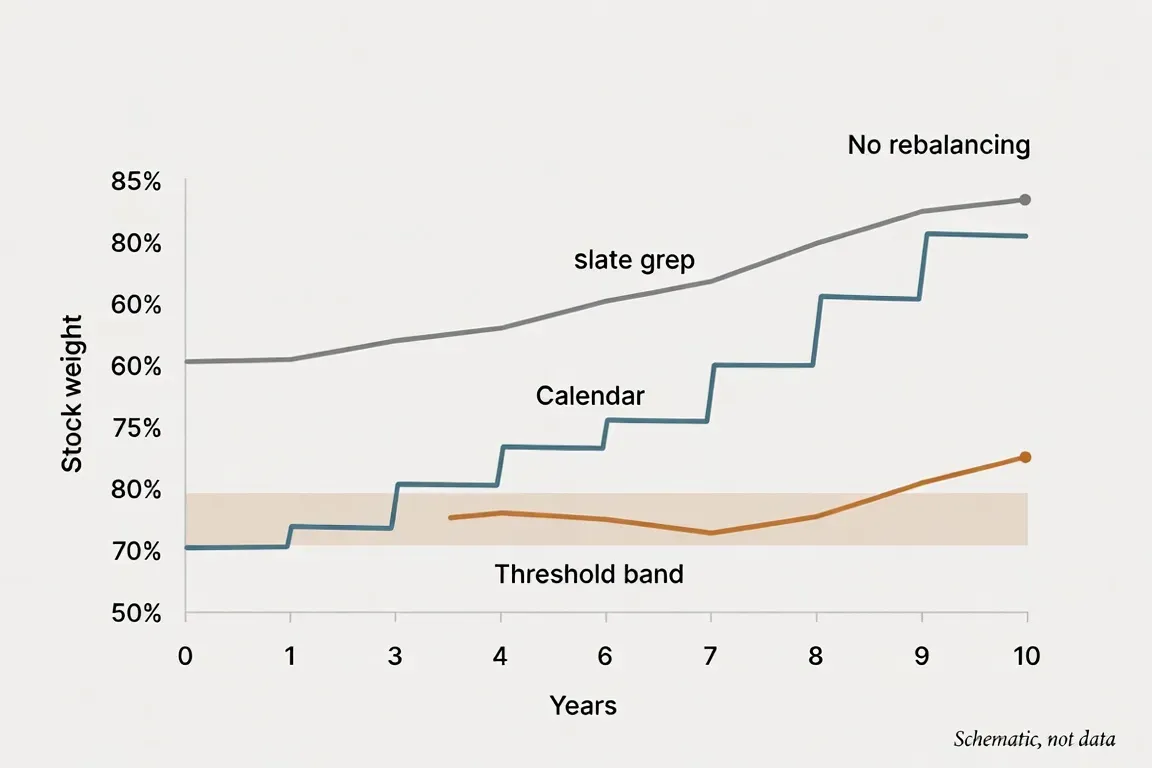
Now picture a whole city of timers, all set to 6:00. The grid sees a spike at the same minute every morning, and anyone who sells electricity learns to price that spike. This is the paper’s real complaint. Large pools of money rebalance mechanically on predictable dates, all in the same direction, and that turns them into a trade others can see coming and position against. The authors want policies that “preserve the benefits of rebalancing while minimizing its costs.” They keep the habit and change the predictable timing.
The arithmetic invites one shortcut, so here is an honest caveat. The paper’s average cost estimate is about 8 basis points, and 18 minus 8 leaves a comfortably positive number. The authors never do that subtraction, though. The two figures come out of different calculations, and I’m not going to put a net figure in their mouths. What I’d say is narrower: nothing in the paper suggests the cost eats the benefit, and the authors don’t conclude that it does.
Why it feels wrong anyway
The psychology is the most revealing part, and it explains why the headline landed so easily. Rebalancing means selling what has done well and buying what has hurt you. The paper calls rebalancers “macro-contrarians”. Contrarian is a flattering word to use about yourself and an uncomfortable thing to actually do when the moment comes.
The household data makes the point better than I can. Swedish households turn out to be contrarians on average. U.S. households, on average, are pro-cyclical: they lean into whatever has been rising. The exception is the ultra-wealthy, who behave more like the Swedes. I wouldn’t build a whole theory on one finding (I have been wrong about tidier patterns than this one), but it fits something I have watched for 25 years. Leaning against the wind is hard, and most people only manage it when a specific rule does it for them.
That is why a cost headline is so tempting. It gives you an intellectual reason to do what your gut wanted all along: let the winners run and stop selling them. Doing nothing starts to look like the sophisticated choice. Underneath, it is still drift, just with a footnote attached.
The doubt the authors left in
The line I respect most in the paper is the one where the authors refuse to defend their own starting point. “It is far from obvious,” they write, “that a continuously rebalanced 60/40 portfolio is optimal for investors – or for pensioners.” They take the fixed target as given and say plainly that finding the optimal portfolio is not the question they are answering.
That separation is worth keeping in your own thinking. Rebalancing does not make a target right; it makes the target stick. If you chose 60/40 for good reasons, rebalancing keeps you at 60/40 instead of letting the market pick 80/20 for you. If you chose it for bad reasons, rebalancing will faithfully preserve those as well. None of this tells you what your own mix should be. The authors decline to say, and I’m certainly not going to say it here either.
So what you should take from the paper is not that rebalancing is a mistake. The useful question is a smaller one: do you know what you are rebalancing toward, and does your rule fire on the same morning as everyone else’s?
Risk Disclaimer The contents are for information purposes only. Capital investment involves risks. No investment advice.
Social Trading Portfolio
Copy my trades in real-time on eToro – transparent and efficient.